Termite Tenting in Florida: Cost, Prep, How Long You're Out, and Alternatives
Termite tenting in Florida: what companies charge, how long you must stay out under the 2024 label, how to prepare food, medicine, pets and plants, and when a spot treatment will do.
Published · Updated · How we source this
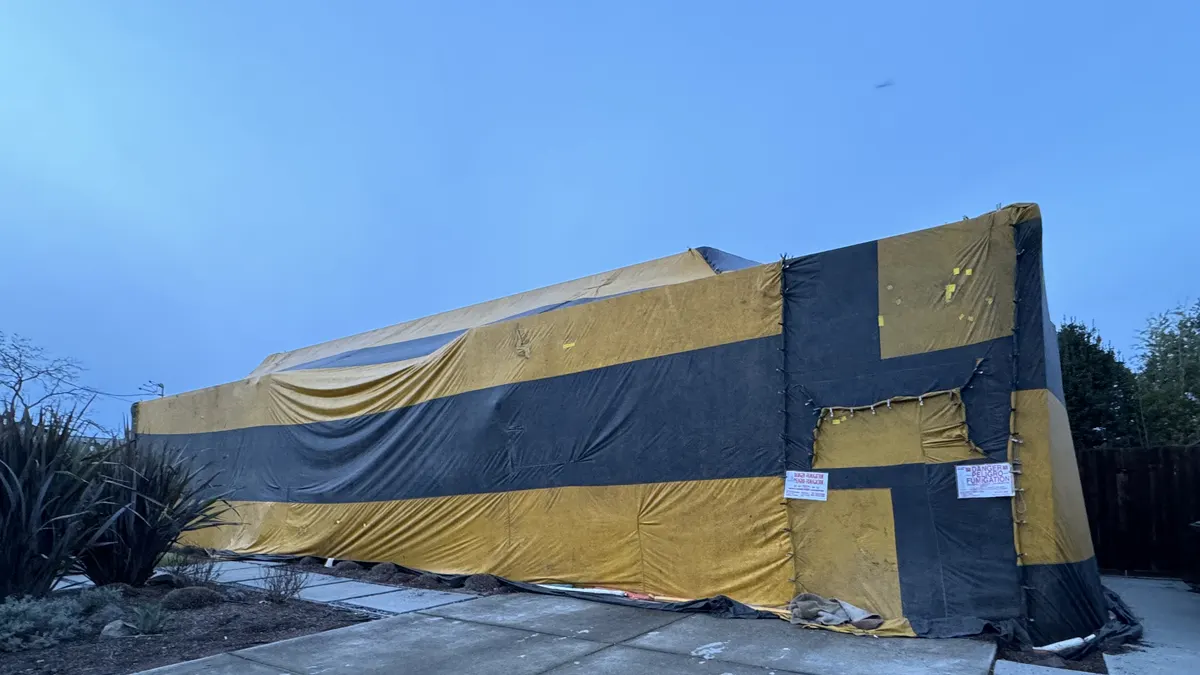
Termite tenting in Florida usually costs about $1,000 to $3,000 for a typical house, going by the prices Florida fumigation companies publish, and the bill follows the size of the house and the dose of gas. Once the tarps are first opened, the fumigant label bars anyone from going back in for at least 12 hours, longer at higher doses, and only after every room tests at 1 part per million or less. Miami fumigation companies tell customers to plan on two to three nights away.
When you’re ready to compare prices, start with termite companies in Miami, Tampa or West Palm Beach, and ask for at least two written quotes. The prep checklist and the alternatives to tenting are further down.
What termite tenting costs in Florida
Nobody publishes an independent survey of tenting prices in Florida. On 27 Sep 2026 we looked for Tampa companies posting a tenting price on their websites and found none. The figures below are what three South Florida fumigation companies post on their own sites. They are those companies’ prices, and we have no state average to set them against. For how tenting prices compare with other termite treatments, see our termite treatment cost guide.
| Company page (area, date) | Published tenting price |
|---|---|
| Hoffer Pest Solutions (Broward, Palm Beach, Miami-Dade; Feb 2025) | “$1,000 to $3,000” statewide, or $1.00 to $2.00 per square foot |
| Time’s Up Fumigation (Miami; Jan 2026) | Same range for a standard home; $3,000 to $5,000 for 2,500 sq ft and up |
| Rest Easy Pest Control (Miami-Dade; Apr 2026) | About $1,800 to $2,800 for 2,000 sq ft, priced on cubic footage |
The sources are the company pages from Hoffer, Time’s Up and Rest Easy. Hoffer’s page also lists one 2,600 sq ft house at $8,700, far above its own range.
Square footage is a shortcut. On the Vikane label, the fumigator sets the dose from the enclosed volume, the temperature, the exposure time and how fast gas escapes the tarps (Vikane label, 2024). A two-storey house or one with vaulted ceilings needs more gas than a ranch house of the same floor area, and a cool week needs more than a hot one. Ask each company what its quote is based on.
Under Florida’s rule on termite contracts, you get the written contract before any work starts and before you pay anything. It lists every building on the property to be treated and states the organisms covered. The maximum treatment price appears on its own line, apart from any annual renewal fee and any maximum charge for structural repairs (Fla. Admin. Code r. 5E-14.105). If a quote leaves one of these out, ask for it in writing. A tenting warranty is a separate document from a soil-treatment termite bond, so ask which one you’re getting.
How long you’ll be out of the house
EPA approved a new Vikane label on 11 July 2024 after its Inspector General reported that the agency “can better prevent deaths and serious injuries” during home fumigations (EPA). FDACS told Florida licensees that product distributed after 11 July 2025 must bear the new labeling (FDACS notice, July 2025).
| Stage | What happens | Minimum time under the 2024 label |
|---|---|---|
| Before tent day | You prepare the house and receive the Fact Sheet for Vikane | Set by the company |
| Tent up | Tarps go on, a warning agent is released, then the fumigant | Set by the dose; two Miami companies quote 24 to 72 hours under the tarps |
| Active aeration | Tarps opened, with windows and doors open and fans running | At least 2 hours (the old label said 1) |
| House locked | Counted from the first opening of the tarps | At least 12 hours at doses up to 16 oz per 1,000 cu ft (the old label said 6); 14 to 24 hours at higher doses; 24 hours if the day’s high is under 40°F |
| Clearance | Every room’s breathing zone tested with a clearance device | Nobody moves back in until each room reads 1 ppm or below |
The timings come from the current label and the 2015 label it replaced. The tarp time and the two to three nights away are what Rest Easy and Time’s Up tell their customers.
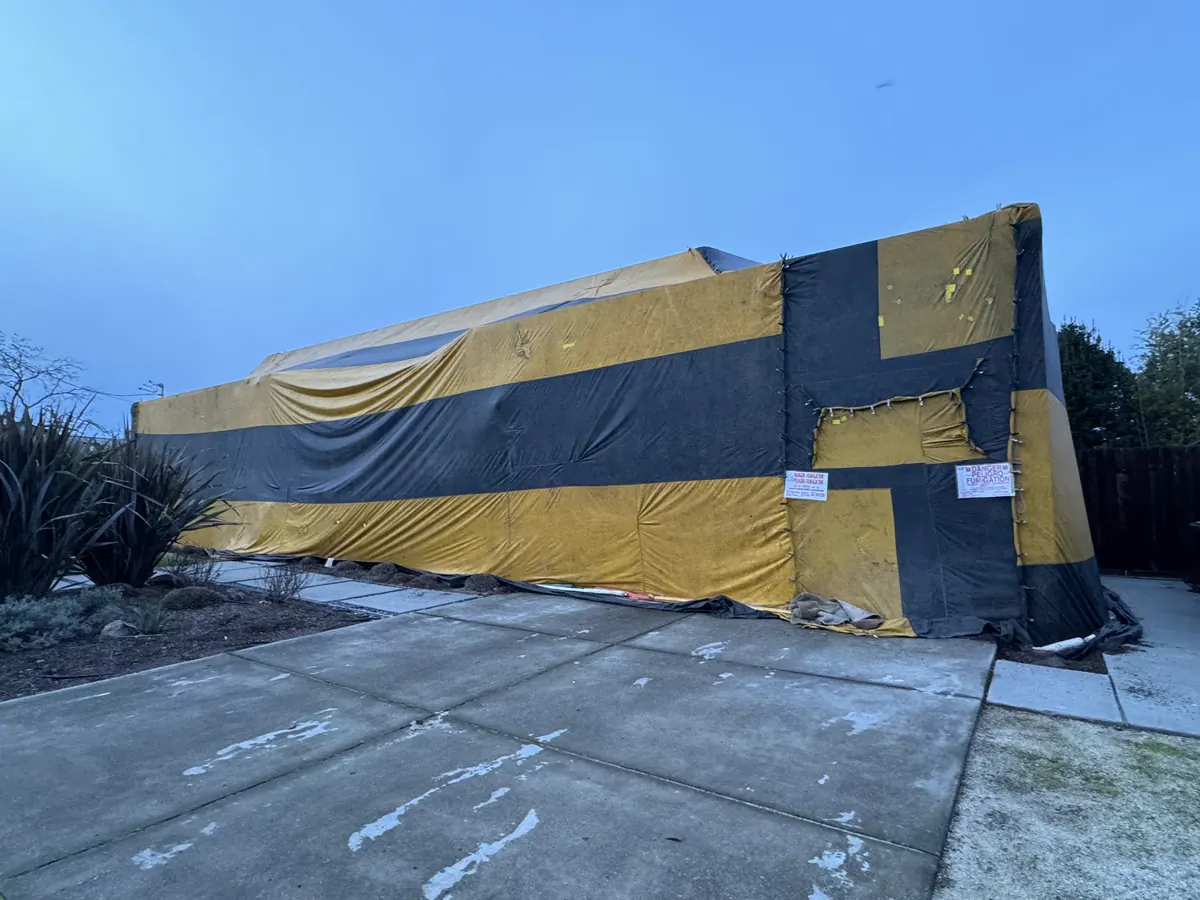
How to get the house ready
These items come from the current Vikane label and the FDACS structural fumigation FAQ. Your fumigator’s checklist may add more.
- Everyone leaves, with pets and houseplants. The label says “desirable growing plants” must go, and its fumigation manual covers fish tanks.
- Food, drink, medicines and tobacco, including what’s in the fridge and freezer, can stay only in plastic, glass or metal containers with the maker’s airtight seal intact. Everything else leaves the house or goes into double Nylofume bags, which Vikane distributors sell.
- Open the waterproof covers on mattresses and pillows, or take them out. Covers with built-in air vents can stay as they are.
- Put out every flame, including pilot lights on water heaters, gas ranges, ovens, dryers and gas fireplaces, and unplug electric heating elements.
Inside, open interior doors, cabinets, closets and appliances such as dishwashers and ovens. FDACS adds dresser drawers left partly open and lids ajar on plastic storage boxes. An adult in the household must receive the Fact Sheet for Vikane once the contract is signed.
FDACS says the fumigator needs immediate access in an emergency, so expect to hand over keys. The label’s manual also notes that some states ask customers to accept in writing the risk of damage to plants under the tarps and to fragile features such as tile roofs.
Is termite tenting safe?
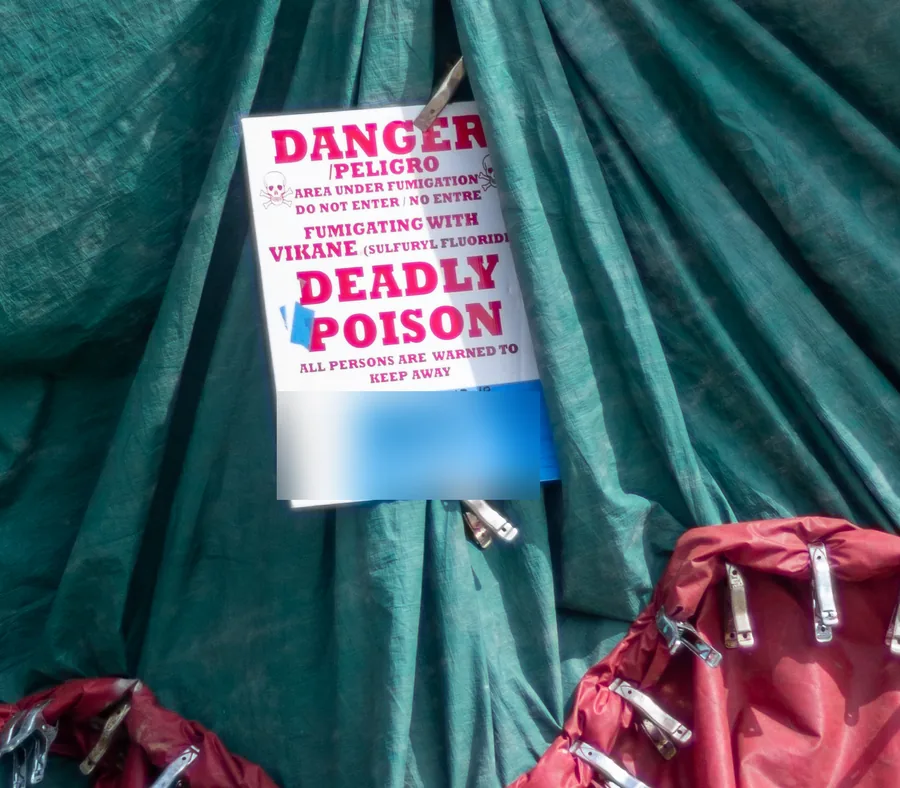
The gas is sulfuryl fluoride, which has no color or smell. FDACS lists breathing problems, nausea, fluid in the lungs and convulsions among the effects of high exposure. Safety rests on the steps the fumigator must follow, and Florida rewrote those rules effective 18 May 2026 (FDACS memo, Fla. Admin. Code ch. 5E-14). What you should see:
- Warning signs visible from every direction the house can be approached, now with “PELIGRO”, “DO NOT ENTER/NO ENTRE” and the fumigant’s brand name (rule 5E-14.112).
- A warning agent, chloropicrin, released before the fumigant to warn of the fumigation (Vikane label).
- The licensed applicator plus a second trained person on site while the gas goes in. After the first hour of active aeration the second person may leave if readings are low enough, but FDACS says active aeration “shall not be shortened under any circumstances”.
- A room-by-room test with a permissible clearance device, then a notice on the entrances saying it is safe to go back in (rule 5E-14.113 and the FDACS FAQ).
- A site-specific Fumigation Log, form FDACS-13000 Rev. 03/26, which the company must produce within 3 business days if FDACS asks (rule 5E-14.142).
Condos, townhouses and duplexes
You can’t tent one unit on its own. The label says that when one unit in a larger building is fumigated, every unit in the whole structure must be vacated during fumigation and aeration and prepared as a fumigated structure. Each unit must clear before anyone moves back. Florida’s rule 5E-14.111 also requires the entire multi-unit structure to be vacated. In a condo, that makes tenting a building decision, so start with the association.
Alternatives to tenting
Tenting is for drywood termites, whose colonies live inside the wood. UF/IFAS says that when an infestation is “inaccessible or widespread”, fumigation is the primary method of control (UF/IFAS IN236). If the inspector can find and reach every colony, you have other options. Our guide to signs of termites covers the clues that tell you which situation you’re in.
| Situation | Option | Evidence |
|---|---|---|
| One piece you can get at, such as a door frame or trim | Spot treatment injected into the galleries, or replace the wood | UC IPM: control is high when the colony is found and treated directly, but the extent of an infestation is hard to judge (UC IPM) |
| One room or one apartment | Heat, where offered | UF/IFAS says Florida uses heat for single rooms or units, and rarely for whole houses; wood must reach 120°F for at least 33 minutes (UC IPM Pest Note 7440) |
| Pellets in several rooms, the attic or framing you can’t open | Tenting | UF/IFAS IN236 |
Spot treatments depend on hitting the colony. In one field study on the West Indian drywood termite, insecticides injected into naturally infested pallets killed 18% to 59% of the termites, and the authors wrote that “none of the insecticides produced commercially acceptable mortality” (Woodrow, Grace and Oshiro, 2006). Tenting leaves nothing in the wood afterwards, so it can’t stop new swarmers moving in (UC IPM Pest Note 7440).
Tenting won’t treat subterranean termites, Formosan termites included, because they nest in the soil. UF/IFAS calls termite treatments “target-specific and are often mutually exclusive” (UF/IFAS IN1360). The Vikane label also sets the Formosan dose at 4 times the drywood dose, so a tent dosed for drywood termites is too weak for Formosan. Mud tubes and no pellets call for a liquid or bait treatment instead.
Who can tent your house
Florida certifies pest control operators in separate categories, and fumigation is one of them (Fla. Stat. sec. 482.111). The company that tents your house needs a certified operator in fumigation. Vikane is a restricted-use pesticide, so there is no do-it-yourself version.
To check a company, search the FDACS licence portal or call FDACS on (850) 617-7997, Monday to Friday, 8 a.m. to 5 p.m. Florida business licence numbers start with “JB” (FDACS).
Since 1 July 2026, a business that fumigates must insure bodily injury at $1 million per person and $2 million per occurrence, and property damage at $1 million per occurrence and $2 million in aggregate. A $2 million combined single limit is the alternative (FDACS memo, June 2026). Ask for the certificate.
A fumigation licence alone does not let a company write a Florida WDO report for a sale. That needs the termite and wood-destroying organism category. Our guide to drywood termites in Florida covers the WDO report and what a termite contract must say about drywood.
Get tenting quotes
UF/IFAS says nearly all structural fumigation in Florida is for the West Indian drywood termite, whose largest populations are in older buildings in the southern half of the state (IN236). Compare termite companies in Miami, termite inspection in West Palm Beach, Fort Myers termite and pest control or pest control companies around Tampa. Farther north, see Orlando termite companies and termite control in Jacksonville. Before you sign, confirm the fumigation category on the FDACS portal and check that the contract shows its prices separately.
Common questions
Can I stay in the house during termite tenting? No. Everyone leaves, pets included, until every room passes the clearance test.
Do I have to throw away food after tenting? Factory-sealed food in plastic, glass or metal can stay. Anything else leaves the house or goes into double Nylofume bags (Vikane label).
Does tenting kill subterranean termites? No. Their colonies live in the soil, which the gas doesn’t reach (UF/IFAS IN1360).
Does tenting protect the house afterwards? No. The gas leaves nothing in the wood, so new swarmers can start fresh colonies later (UC IPM).