Drywood Termites in Florida: How to Tell and Whether to Tent
Found pellets or winged insects in your Florida home? How to tell if it's drywood termites, what to do this week, and whether to tent or spot treat.
Published · Updated · How we source this
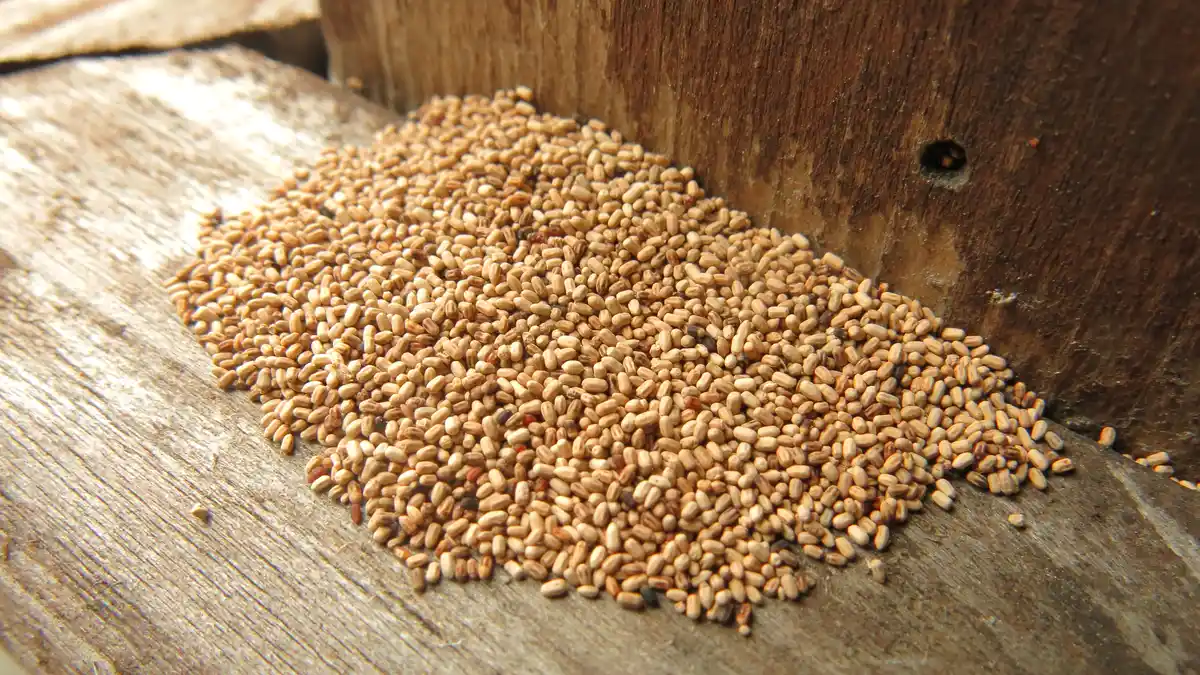
In Florida, drywood termites usually show up in one of two ways: a small pile of hard, six-sided pellets under a pin-sized hole in wood, or brown winged termites around indoor lights on a spring evening. A colony takes about five years to produce swarmers, so there is time to get an inspection and compare quotes before you sign anything. If the inspector finds one colony in a door or a piece of trim, it can be spot treated or the wood replaced. Pellets in the attic or framing usually mean tenting the house.
To get an inspection and quotes, start with termite companies in Miami, West Palm Beach termite inspection, Fort Myers termite and pest control companies, pest control companies around Tampa, Orlando termite inspectors or termite control in Jacksonville.
Is it drywood termites?
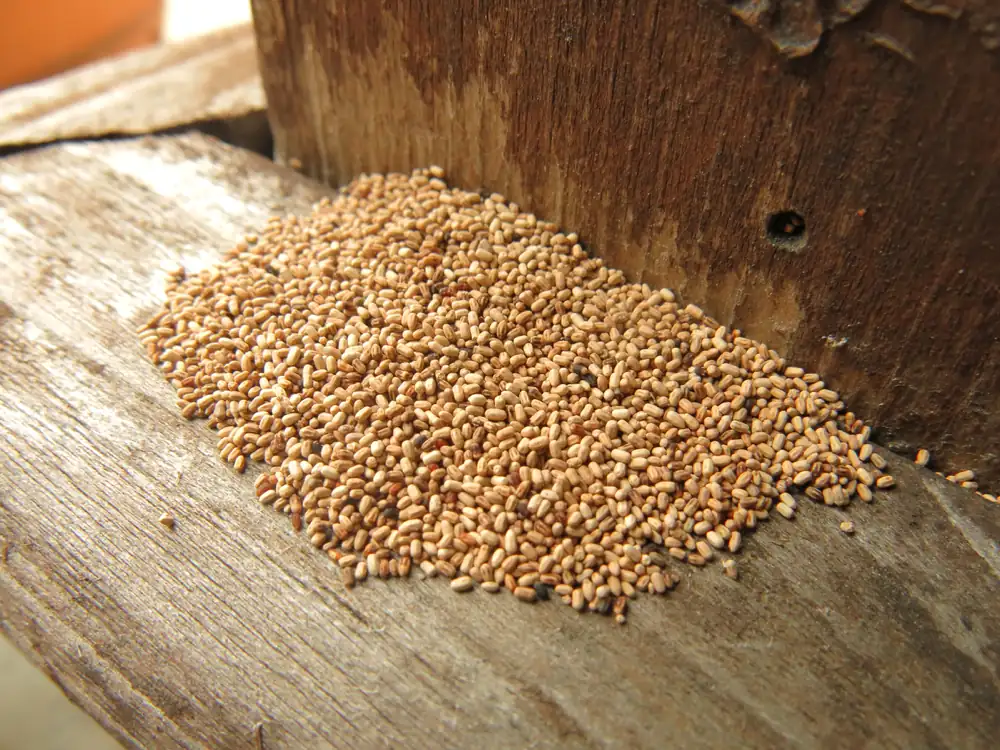
Workers push their droppings out of “kick-out” holes usually 1 to 2 mm across, and under a magnifying glass each pellet is six-sided. Colour ranges from cream to red to black and has nothing to do with the colour of the wood (UF/IFAS IN236).
| What you found | What it points to | Source |
|---|---|---|
| Hard pellets, all one size and six-sided when magnified, piled below a hole of 1 to 2 mm | Likely drywood termites | UF/IFAS IN236 |
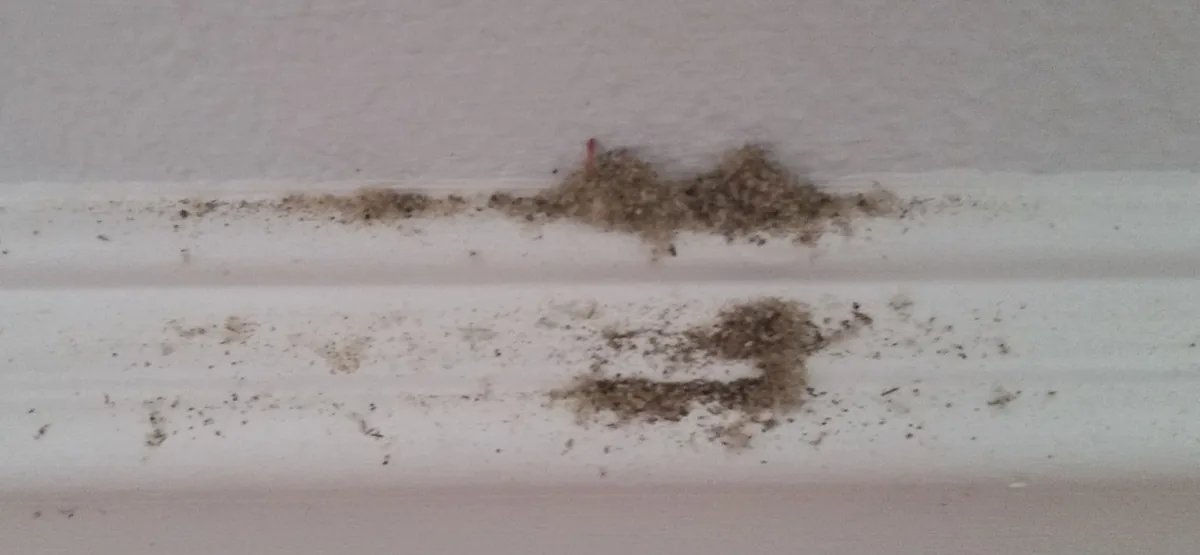
| Fibres like pencil shavings, with bits of ants and other insects mixed in | Carpenter ants | NC State Extension |
| Mixed sizes, from fine dust to splinters, below a saw or drill mark | Sawdust from drilling or repairs | Our termite droppings guide |
| Mud tubes on a foundation wall and no pellets anywhere | Likely subterranean termites (Formosan included) | UF/IFAS IN1360 |
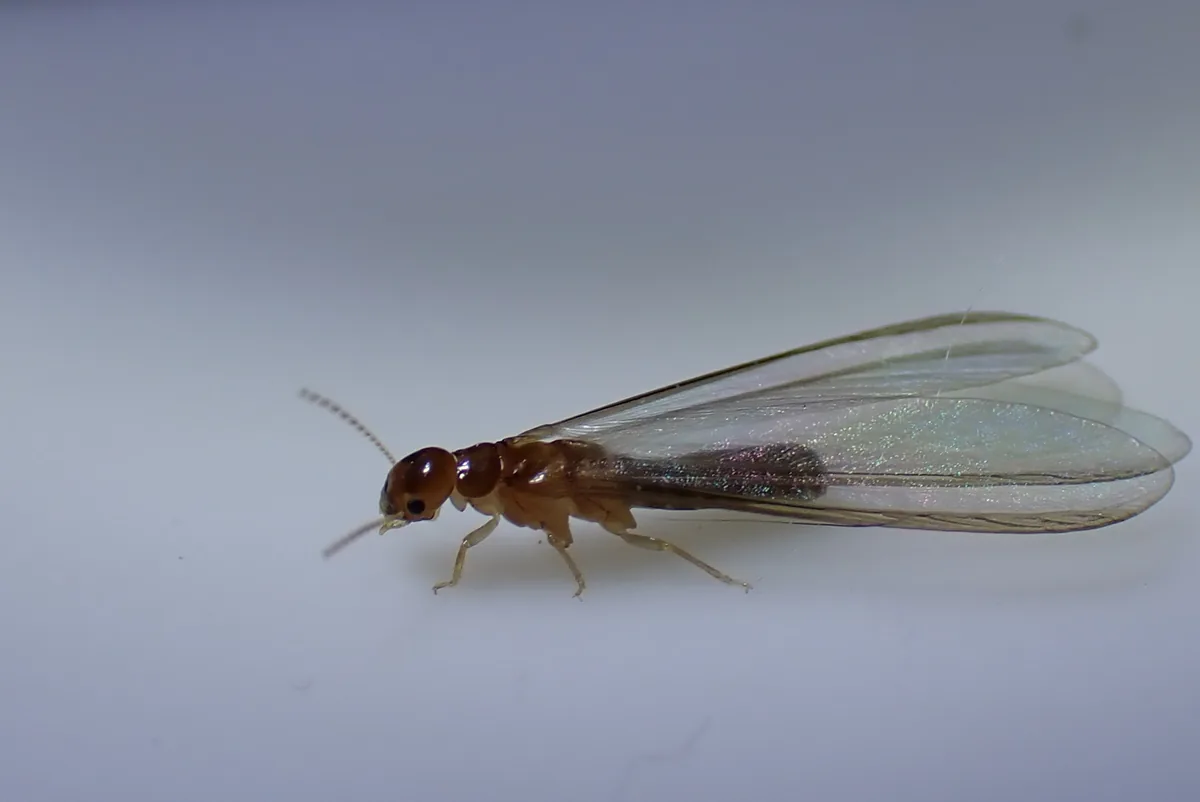
| Medium-brown insects about half an inch long with two pairs of hairless, iridescent wings, each with 3 or 4 dark veins along the front edge, at lights on an April to June evening | Likely drywood termite swarmers | LSU AgCenter; IN236 |
| Winged insects that don’t match that description | Ask the inspector to identify them |
Not sure whether winged insects are termites or ants? Our guide to termite swarmers has a side-by-side comparison. For the full range of clues beyond pellets and wings, see our guide to signs of termites.
UF/IFAS also lists thin paint or surface wood that blisters or peels where galleries run just underneath (IN236). Mud tubes matter because the whole drywood colony is inside the wood, so the liquid and bait treatments used for subterranean termites do nothing for it (IN1360).
What to do this week
- Don’t spray the pellets or the wood. In field tests, even insecticide injected straight into infested wood killed only 30% to 59% of the termites (details below).
- Photograph the pile and any wings, then sweep the pellets up and tape a sheet of paper under the spot. Old pellets shake loose from dead galleries (IN236), so a pile alone doesn’t prove a live colony (UC IPM). Fresh pellets on the paper over the next few weeks mean the colony is feeding.
- Check windowsills and light fixtures for wings, and door and window frames, trim, cabinets and wooden furniture for pellets. Look in the attic if you can get into it safely. Colonies travel in infested furniture (IN1360), so check older pieces too.
- Book an inspection. The Florida Department of Agriculture and Consumer Services (FDACS) treats wings on a windowsill as reason enough to call for one (FDACS drywood page). Use a company licensed for termite and WDO work, and ask the inspector to mark every spot with pellets on a sketch of the house.
Tent or spot treat?
It depends on whether the termites are in one piece of wood or many, and whether the inspector can find and reach every colony. See our termite treatment options guide for how tenting compares with the other methods. UF/IFAS: “In the event of inaccessible or widespread infestation of a structure, the primary method of control is fumigation” (IN236). UC IPM says spot methods work well when the colony is located and treated directly, but the extent of a drywood infestation is hard to judge, so complete control is harder.
| What the inspector finds | What usually fits | Time away from home |
|---|---|---|
| Pellets in several rooms, the attic or framing you can’t open up | Whole-house fumigation (tenting) | By label, at least 12 hours after the tarps open at standard doses; one Miami-area company tells customers to plan for 2 to 3 nights |
| One piece you can get at: a door frame, window trim, furniture | Spot treatment, or replace the wood | No figure published |
| One room or one apartment, and you can’t leave for days | Heat, where offered | A matter of hours (UC IPM) |
| Mud tubes and no pellets | A liquid or bait treatment for subterranean termites | Not a drywood treatment |
The evidence on spot treatment is thin. When researchers injected insecticides into wood naturally infested with C. brevis, Florida’s main drywood species, the best (spinosad) killed 53.3% to 58.7% of the termites and a borate 30.4%. The authors wrote that “none of the insecticides produced commercially acceptable mortality” (J. Econ. Entomol. 99(4)). UF/IFAS treats borate sprays and foams on bare wood as prevention (IN236). Replacing an isolated infested piece, such as a door, is a fix both UF/IFAS and FDACS list.
A tent doesn’t leave any residue in the wood, so it can’t stop new swarmers flying in later (UC IPM Pest Note 7440). The fumigant is a restricted-use pesticide with no homeowner version. The dose is set for drywood termites: on the Vikane label the Formosan termite dose is 4 times higher, and Formosan colonies in the soil are out of the gas’s range anyway (Vikane label). In a condo or townhouse, one unit can’t be tented alone (see below). Our guide to termite tenting in Florida covers the preparation, the timeline and the rules in full.
What treatment costs in Florida
Nobody publishes an independent price survey for drywood treatment in Florida. These are tenting prices Florida fumigation companies post on their own sites.
| Company page (area, date) | Published tenting figure |
|---|---|
| Hoffer Pest Solutions (Broward, Palm Beach, Miami-Dade; Feb 2025) | “$1,000 to $3,000” for Florida tenting, or $1.00 to $2.00 per square foot |
| Time’s Up Fumigation (Miami; Jan 2026) | $1,000 to $3,000 for a standard home; $3,000 to $5,000 for 2,500 sq ft and up |
| Rest Easy Pest Control (Miami-Dade; Apr 2026) | About $1,800 to $2,800 for 2,000 sq ft, priced on cubic footage |
Hoffer’s page also gives one 2,600 sq ft example at $8,700, well above its own range. Floor area is only a stand-in, because the label doses by enclosed volume and adjusts for temperature, exposure time and gas loss through the tarps. A two-storey house, or a cool week, needs more gas than floor area suggests.
We didn’t find a Florida company publishing a price for drywood spot treatment or heat. The spot-treatment figures on city-labelled cost sites are national estimates, so we leave them out. Ask each company for a written quote and what it is based on. For typical costs across other termite treatments, see our termite treatment cost guide.
When drywood termites swarm in Florida
UF/IFAS rates one drywood species a major structural pest in Florida: the West Indian drywood termite, Cryptotermes brevis (IN1360). It swarms mainly from April to June, “though flights are possible any time of the year” (IN236), between dusk and dawn, flying to lights (UF/IFAS, 1999 edition).
Several company pages that rank for this topic put the drywood swarm in “late summer or fall” or from May to September, and cite nothing. The autumn pattern fits the much rarer western drywood termite (24 confirmed Florida records), with half its recorded flights from September to November, in daylight and indoors (UF/IFAS IN526). An April evening swarm around a porch light is most likely C. brevis.
A swarm also dates the colony. UF/IFAS says swarmers appear only at maturity, about five years in (IN236), and FDACS puts the first ones at year four to seven. There may be other colonies nearby.
Your termite contract has to say “drywood”
Florida’s rule on termite contracts says any contract for treating or preventing termites “must clearly state on the first page if the contract covers subterranean termites, dry wood termites, or both.” Excluded species such as Formosan termites have to be named (Fla. Admin. Code r. 5E-14.105).
A bond bought after a soil treatment may say “subterranean” on page one and nothing else, and then drywood termites found later are not covered. Read page one before you rely on a bond, and again before you sign for tenting. The same rule gives the company 30 calendar days to inspect after your written notice and 90 days to retreat once it finds an infestation (180 days for commercial and multi-unit buildings). A tenting warranty is a promise to come back and treat again.
How drywood termites appear on a Florida WDO report
In a sale, drywood termites go on the state’s Wood-Destroying Organisms Inspection Report, form FDACS-13645 (rule 5E-14.142). A pellet pile with no live termites seen goes down as “evidence”, and a past fumigation can show up as previous treatment. Only a company with a certified operator in the termite and wood-destroying organism category can write the report, so a fumigation-only company can tent your house but can’t write it. Our WDO inspection page and the guide to what a WDO inspection covers in Florida explain the rest.
Condos, townhouses and duplexes
Florida’s rule says that if one or more units in a multi-unit building are fumigated, “the entire multi-unit structure must be vacated” and each unit tested for clearance. If that can’t be done, the fumigation can’t go ahead (rule 5E-14.111). The Vikane label adds that nobody moves back in until every unit clears. A drywood problem in a Miami or West Palm Beach condo goes to the association before it goes to a fumigator.
What changed for tenting since 2024
The Vikane label EPA approved on 11 July 2024 doubled the minimum lock-out at standard doses from 6 to 12 hours after the tarps open, and nobody goes back in until every room reads 1 part per million or less (2015 label, 2024 label above). FDACS applies it to product distributed after 11 July 2025 (FDACS notice), and Florida amended its own fumigation rules effective 18 May 2026 (FDACS memo). The tenting guide explains what changed.
Common questions
Are drywood termites common in Florida?
C. brevis was first recorded in Florida in 1918, in Key West, and has spread through the coastal regions of the state, with the largest populations in “older buildings in the southern half of Florida” (IN236). UF/IFAS says “Nearly all structural fumigation in Florida and Hawaii is for Cryptotermes brevis control.”
How fast do drywood termites damage a house?
We don’t publish a figure. The rates quoted online come from lab studies that disagree with each other widely, and none is Florida field data.
Find a termite company in Florida
Florida licenses pest control by category under Fla. Stat. sec. 482.111. For tenting, confirm the company is licensed in fumigation. For an inspection, a spot treatment or a WDO report, confirm the termite and wood-destroying organism category. The FDACS licence search lists the categories for each business.
C. brevis is concentrated in the south and along the coasts, so start with drywood termite treatment in Miami, termite companies in West Palm Beach, Fort Myers termite control or termite tenting companies in Tampa. Inland and in the north, compare termite companies in Orlando and Jacksonville termite inspection. Get at least two written quotes, each with a sketch of where the inspector found pellets, so you can judge whether a spot treatment is realistic.