Termite Bond: What It Covers in Florida and Texas, and What Voids It
A termite bond is a service contract, not insurance. What retreatment-only versus repair really means in Florida and Texas, what voids it, what transfers on a sale, and what it costs.
Published · How we source this
A termite bond is a service contract with a pest control company. It isn’t insurance, and no government agency backs it. One phrase printed near the top of the contract sets what it actually pays for: retreatment only, or retreatment and repair. A retreatment-only contract gets you a free follow-up treatment. A retreatment-and-repair contract pays toward the repair bill too, up to a stated limit.
If you’re renewing a bond, or you’re buying a house someone told you “has a bond,” pull out the contract and read the first page. Florida law requires that answer to sit there in bold print. Texas doesn’t require the same format, so you may need to ask the company directly.
Either way, get quotes or compare termite companies in Tampa or termite companies in Houston before you sign anything, or before you let an existing bond lapse.
Two obligations, priced separately
A termite bond bundles a service obligation and a repair obligation, and companies price them differently. The service obligation covers reinspection, usually once a year, plus a new treatment if termites come back. The repair obligation covers damage the termites caused, and it’s the one most bonds skip or cap.
Nearly every bond includes the service obligation. Far fewer include the repair obligation, and the ones that do almost always cap the payout at a stated dollar figure rather than covering repairs without limit.
Homeowners insurance won’t fill the gap either. The Texas Department of Insurance lists termites, insects, rats and mice under the damage most policies exclude (TDI consumer bulletin CB-025, updated 1 June 2026). That exclusion is the entire reason this product exists.
Florida: what has to be on page one
Florida puts the disclosure requirement in statute. Fla. Stat. § 482.227 requires a termite contract to state on the first page, in bold print, whether it offers retreatment and repair, retreatment only, or no warranty at all. The same section requires bold disclosure of any disclaimers, limits, conditions or exclusions on page one, with bold section headings over them, and it bans pairing the words “full” or “unlimited” with “guarantee” or “warranty” anywhere a real limit applies.
FAC rule 5E-14.105 adds a second, more specific requirement to check for by name. A Florida contract has to state on page one whether it covers subterranean termites, drywood termites, or both, and if Formosan termites are excluded from coverage, the rule says the contract has to name them: “If Formosan termites (Coptotermes formosanus) are to be excluded from coverage, this species must be named as excluded.” If your contract just says “termites” with no Formosan exclusion named, you’re covered for them.
That same rule sets a deadline on the company’s response. A licensee must retreat an infested area within 90 days of finding it under an active contract, or within 180 days for a commercial or multiunit building. The contract also has to list the maximum treatment price, the exact annual renewal fee, and, separately, the maximum repair price if repairs are covered at all.
Put together, a Florida contract’s first page should tell you which tier you have and what the dollar caps are, and it should name Formosan termites if they’re excluded.
Texas: a lighter disclosure rule
Texas regulates termite contracts through the Texas Department of Agriculture, under Texas Administrative Code Title 4, Part 1, Chapter 7, Subchapter H. On its face, every contract, warranty or guarantee a TDA-regulated business issues must show the business name and licence number. It also needs the address, the phone number, and a statement naming TDA as the regulator.
Current TDA rule text stops short of Florida’s bold, page-one, retreat-versus-repair format. It points consumers to the pesticide label for minimum treatment specifications instead of mandating one layout every company has to follow. The retreat-only-versus-repair distinction still exists in a Texas contract, but nothing guarantees it’s printed in bold on the first page. Ask the company directly if a Texas contract doesn’t say plainly, and get the answer in writing.
Texas real estate transactions run on the Texas Official Wood Destroying Insect Report, and a durable sign gets posted near the water heater closet, the breaker box, under the kitchen sink, or the bath trap access, showing the inspection date and the licensee’s name. Anyone buying a Texas house should find that sign before assuming anything about coverage that’s already in place.
A bond sits on top of a treatment. If you have not chosen one yet, our comparison of liquid and bait treatments explains what each involves.
What can void a bond
Contract terms vary, but a few conditions show up across most of them. A lapsed renewal payment stops coverage, sometimes without the company flagging it in advance. An addition, a deck, or new landscaping that puts wood in contact with soil can open a gap in a treated barrier that the original contract never accounted for. Moisture near the foundation, drainage problems, and wood-to-soil contact are the “conducive conditions” most contracts put on the homeowner to fix. And a missed annual inspection, even if payments kept coming, is grounds some companies treat as a lapse.
Texas A&M AgriLife’s guidance for choosing a termite company puts the underlying point plainly: “Read the warranty carefully as it is a guarantee of service, not a guarantee of the termite barrier. Do not accept guarantees that vaguely refer to termite control.” On the company behind the paper: “A warranty is no better than the person or firm who gives it to you.” (E-369, Texas A&M AgriLife Extension, Dec. 2005.)
Buying a house that already has a bond
A seller or agent telling you the house has a bond doesn’t mean you’re covered the moment you close. A bond is a contract between the pest control company and whoever signed it, and whether that contract transfers to a new owner depends on its terms, often along with a transfer fee the buyer and seller negotiate between themselves. No neutral source publishes a standard transfer-fee figure. Any number a company quotes you is that company’s own price alone.
The NPMA-33 Wood Destroying Insect Inspection Report, the form HUD names for FHA transactions (HUD Handbook 4000.1), says it plainly: “The inspecting company can give no assurances with regard to work done by other companies. The company that performed the treatment should be contacted for information on treatment and any warranty or service agreement which may be in place.” Before closing, call the company behind the existing bond. Ask whether it transfers, what a transfer costs, and which tier it actually is, and get the answers in writing.
For what the treatment behind a bond usually costs, see termite treatment cost in Florida and Texas.
Get quotes
Browse termite company listings for Orlando, Miami, Jacksonville, West Palm Beach and Fort Myers in Florida, or Dallas and San Antonio in Texas.
What it costs
Aggregator figures cluster around $500 to $2,000 for the initial bond (HomeAdvisor, updated 19 June 2026, and This Old House, updated 17 June 2026, both cited above). That figure is the treatment price with a year of coverage bundled in.
Annual renewal is where a bond’s real cost lives, and it splits by treatment method. Liquid-barrier renewals run roughly $113 to $300 a year in the sources checked here. Bait-system renewals cost 2 to 4 times more, because bait stations need inspecting far more often than a liquid barrier does (NC State Extension, rev. 13 April 2020). The gap matters if a renewal lapses. Coverage fades gradually with a liquid barrier, since some chemical stays in the soil for a while after the contract ends. It doesn’t with bait: once the bait itself is used up there’s no pesticide left behind, so a lapsed bait renewal loses protection right away.
No neutral source quantifies how much more a retreat-and-repair bond costs over retreatment-only coverage. Every figure circulating for that gap traces back to content sites with no stated sourcing. None comes from a university extension office, a government agency, or an aggregator that publishes its methodology. Rather than trust a percentage from somewhere else, ask each company for its own retreat-only and retreat-and-repair quotes side by side.
A standalone annual inspection is often free, since the company doing it hopes to sell you a bond or a treatment afterward. A paid real estate or WDO inspection runs $100 to $200; a VA-specific inspection runs $50 to $150 (HomeAdvisor and This Old House, both cited above).
Formosan termites and your bond
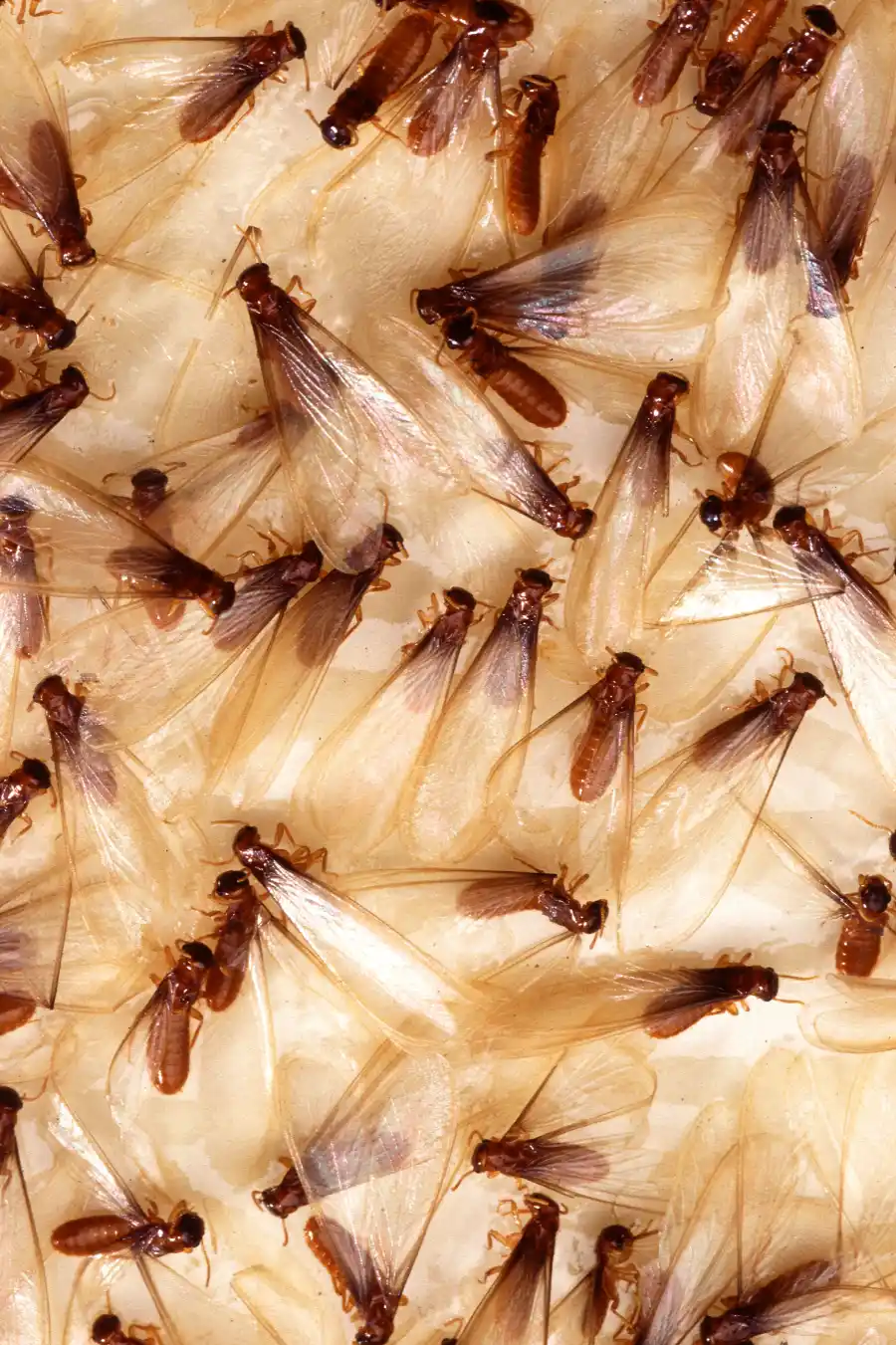
Formosan subterranean termites sometimes show up as a separate line item in a Florida or Texas contract, and asking about one specifically matters most in a Formosan-established area, such as the Houston-Galveston corridor in Texas or much of urban Florida.
Florida’s rule is the one already covered above. If a contract excludes Formosan termites, it has to name them, on page one.
Texas A&M AgriLife’s guidance leans reassuring rather than alarming: “Unless you happen to live in one of the few communities along the upper Texas Gulf coast where Formosan termites are established, there is little need to purchase a pest control contract solely because it includes coverage for this species.” Its bottom line: “For most homeowners, warranties for Formosan termites are usually unnecessary.” (Texas A&M AgriLife, ENT-2002.)
That’s a more specific answer than “check if Formosans are covered.” Outside the upper Gulf coast, paying extra for Formosan-specific coverage in Texas probably isn’t necessary. In Florida, the law already forces the question onto page one, so check it there instead of asking separately.
Questions to ask before you sign or renew
Before signing a new bond or renewing an old one, get written answers to a few questions. Ask whether the coverage is retreatment only or retreatment and repair, and what the repair cap is if there is one. Find out what voids the contract, exactly. Check whether Formosan termites are covered, and if not, whether the contract names that exclusion, which Florida requires on page one. Confirm what annual renewal costs and whether it can rise without notice. Ask whether the bond transfers if you sell the house, and what a transfer costs. Finally, find out what happens if one renewal payment gets missed: does coverage stop right away, or is there a grace period?
Compare quotes from Tampa termite companies or Houston termite companies if you’re shopping for a new bond rather than renewing an existing one.